
There’s a tension a lot of justice-motivated organizations are sitting with right now, and most aren’t talking about it out loud.
It goes something like this: We know what we believe. We know the communities we serve. We know why this work matters. But if we say it the way we’ve always said it, we might lose the funding that keeps it alive.
If that tension sounds familiar, you’re not alone. Organizations of all sizes—scrappy community-based nonprofits, mid-size foundations, established advocacy groups—are wrestling with the exact same issue.
The encouraging news is that a lot of them are figuring out how to stay true to who you are while speaking in a language that keeps the work funded and the doors open. They didn’t panic. They didn’t gut their programs. They got strategic about how they told their story, stayed close to their funders, and let their outcomes do the heavy lifting.
What’s Actually Happening—and Why It Matters for Your Communications Strategy
Before we get into the playbook, let’s name the context clearly.
Thanks to a lawsuit filed by three prominent academic organizations against DOGE’s cuts to the National Endowment for the Humanities, depositions from two former DOGE employees were recently made public. What they revealed should inform every word in your next piece of content.
Here’s how Elon Musk’s agency decided what programs to defund: they asked ChatGPT.
The prompt they used was “Does the following relate at all to DEI?” with instructions to return a yes or no answer in under 120 characters.
One of the deposed employees admitted to having zero government experience before joining DOGE and struggled at length to define what DEI even means. Yet he reasoned that documentaries about Black civil rights or Jewish women in the Holocaust should be defunded because they focused on a “specific group” and were—in his words—”not for the benefit of humankind.”
The search terms DOGE used to identify programs to cut included “Black,” “gender,” “LGBTQ+,” and “equality.” Terms like “caucasian” and “heterosexual” were never searched.
This wasn’t a policy review. It was a keyword search executed by people who couldn’t define the terms they were searching for, and it cost real organizations real funding serving real communities.
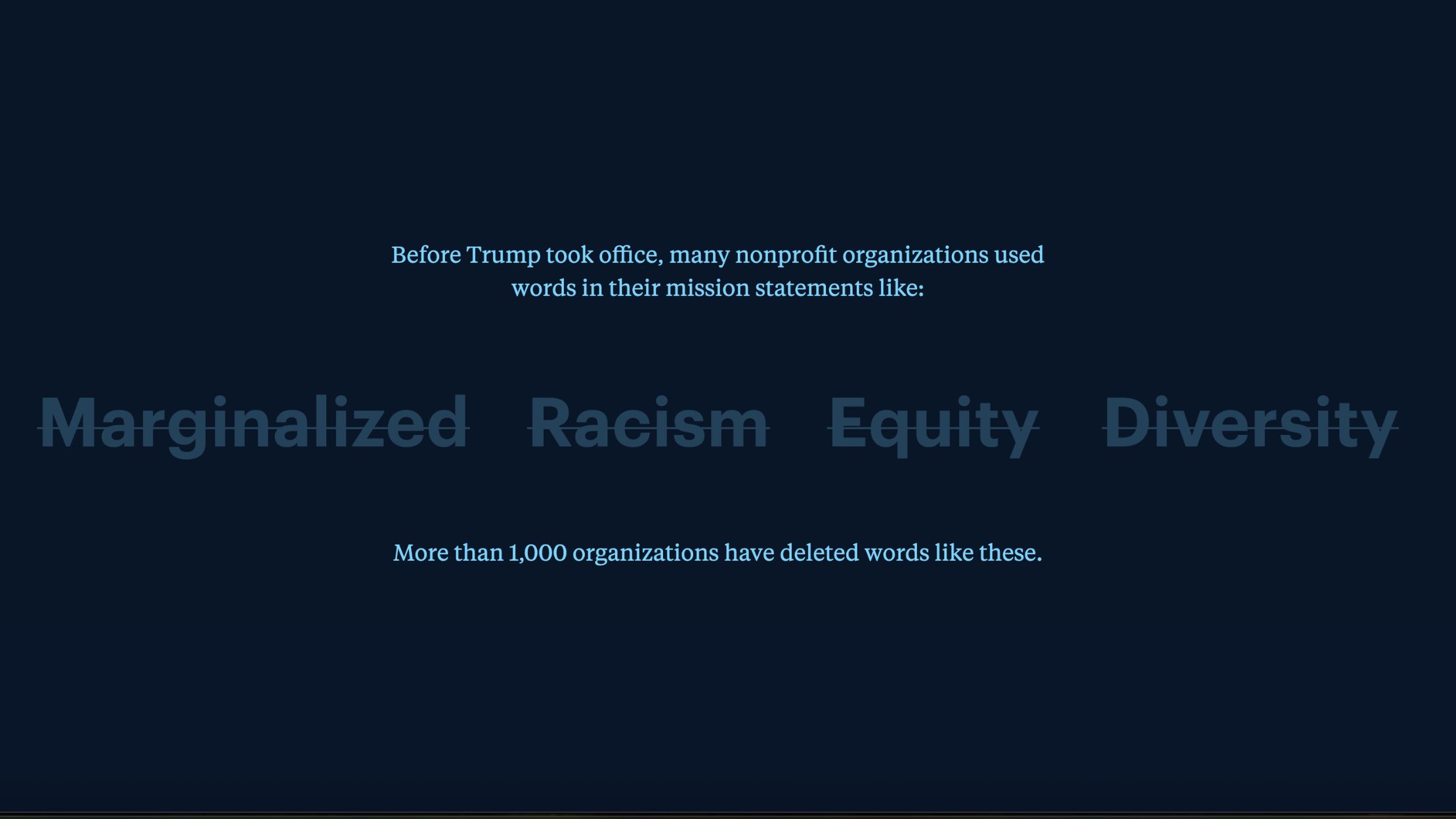
Here’s what that means for you: the organizations that lost funding in this sweep weren’t defunded because their work wasn’t valuable. They were defunded because of the words on their websites and in their grant proposals. And that means the path forward isn’t about changing your mission. It’s about protecting it with smarter messaging.
The Difference Between Gutting Your Message and Code-Switching It
This is the part where a lot of organizations get it wrong—either by changing too much or not enough—so let’s slow down and get specific.
Gutting your message looks like removing all references to the communities you actually serve, scrubbing your website of anything that could be perceived as political, or pivoting your entire programming to chase funding that was never meant for you.
Code-switching your messaging looks like this: describing the same program—one that increases economic opportunity for Black and Brown entrepreneurs who’ve been systematically shut out of capital, for example—as a “small business development initiative focused on closing the wealth gap in underinvested communities.”
The work is identical. The outcomes are identical. The language is calibrated to survive the current environment and reach a wider circle of funders.
The key question to hold yourself to: Is the community we serve still centered in this message, even if we’ve adjusted the framing? If yes, you’re evolving strategically. If no, it’s time to pull it back.
What the Shift Looks Like in Practice
The organizations navigating this moment well aren’t working from some gut feeling.
They’re making real, practical decisions, and some of them are doing it publicly enough that we can learn from them.
CodePath, a nonprofit focused on diversifying the tech industry, updated its mission statement messaging from explicitly naming the communities it serves by race to framing its work around “first-generation and low-income students.”
The population it serves didn’t change. The door that language opens—with a wider range of funders and without triggering an automated keyword sweep—did.
An Ohio nonprofit once called the Financial Alliance for Racial Equity is now the Financial Alliance for Representation and Empowerment.
Same people. Same work. A name that signals the same values in language less likely to get flagged.
These aren’t sellouts. They’re survivors. And their communities are better off because they’re still in the room.
What Organizations That Kept Their Funding Did Differently
What we’ve seen is that organizations that adapted their communications strategy while staying true to their programs were far better positioned than those that didn’t.
The Chronicle of Philanthropy surveyed nonprofit and foundation leaders about how they navigated 2025, and the organizations that held steadiest shared something in common: they moved with resolve, not panic.
Boston Foundation President Lee Pelton put it plainly in a summary of his organization’s 2025 activities: “Moments like this reveal something essential: conviction, courage, and clarity of purpose.”
The for-profit world offers some of the clearest case studies for why doubling down on your values, strategically and visibly, is a viable path through this moment.
e.l.f. Beauty is one of the most striking examples.
The company doesn’t have a DEI team or a chief diversity officer, but inclusion is woven into how it actually operates, from a board that is 78% women and 44% people of color to advertising that consistently features transgender and non-binary models.
The result? Twenty-three consecutive quarters of sales growth and a stock price that increased more than 700% over five years.
Costco took a similarly grounded approach, arguing to its shareholders that its diversity efforts help the company attract and retain employees, improve merchandise and services, and deliver the “treasure hunt” experience its members value.
The commitment paid off in numbers: while Target experienced a 40-day boycott and a $12.4 billion loss in market value after rolling back its DEI initiatives, Costco saw an increase of 7.7 million shopper visits in early 2025, with 68% of Americans surveying in support of the company’s approach.
The lesson from both companies isn’t that you need to be loud or provocative. It’s that when the essence of DEI is genuinely embedded in how you operate—not bolted on as a campaign—it becomes far more defensible.
The values aren’t just on your website. They’re in your outcomes, your team, your decisions.
And that’s the kind of story that holds up under scrutiny, whether you’re talking to a skeptical funder, a nervous board, or a journalist looking for an angle.
Before Your Next Piece of Content Goes Out
We put together a free messaging audit based on the framework we use with our own clients. It combines three gut-check questions we believe every piece of external communication should pass with a practical audit tool you can use before anything goes out to a funder, your board, or the public.
Because here’s the truth: the most justice-driven thing you can do right now is make sure your work survives long enough to keep making a difference.
Smart communications strategy isn’t a compromise of your values. It’s how your values stay alive.