
Your organization is not losing the public’s attention because of bad luck. You’re losing a story you didn’t know you were fighting.
We see this constantly: incredible work, real impact, powerful stories. And, somehow, the world still isn’t paying attention.
That’s because there’s already a story running in your sector, whether you’ve engaged with it or not. It’s shaping what funders assume, what your community believes is possible, and what the general public thinks your issue is even about. And if you haven’t consciously stepped into that story, someone else is writing it for you.
The Center for Story-based Strategy built a framework for exactly this moment. It’s called the Battle of the Story, and it explains, with more clarity than almost anything else we’ve come across, why good work and great impact don’t always translate into public trust and support.
The core insight is this: The obstacle to reaching people is rarely what they don’t yet know. It’s what they already believe.
What the Battle of the Story actually is
Every issue, every community, every cause exists inside a story that is already in motion. That story shapes what people think is possible, what they assume is true, and what kind of future they can even imagine. The Battle of the Story doesn’t ask whether a narrative is shaping the conversation around your work. It starts from the premise that one always is.
The question is: Whose narrative is winning and whether yours is in the fight?
The framework asks you to do two things.
First, get honest about Their Story, the narrative your opposition is telling. Not just the messaging on the surface, but the whole architecture underneath it. Who are the characters? What’s the conflict? What imagery are they using? What does the future look like if their story wins?
And, most importantly, what are the underlying assumptions that have to be true for their story to make sense?
Those assumptions are the real fuel behind the narrative. They’re the part that runs quietly underneath everything, shaping what people believe is possible or inevitable without anyone ever saying it out loud. They’re the reason facts alone rarely change minds.
When someone already holds a deeply embedded belief, new information doesn’t automatically update their worldview. It gets filtered through what they already know, often confirming the story they already believe.
Then build Our Story: not just a counter-argument, not a rebuttal, but a story that actively challenges those underlying assumptions and replaces them with your own. One that centers different characters. That uses different imagery. That names a different conflict. That points toward a different future and makes that future feel possible or inevitable instead.
This is what the Center for Story-based Strategy means when it says the currency of story is not truth, but meaning. What makes a story powerful isn’t necessarily the facts it contains—it’s how it creates meaning in the hearts and minds of the people who hear it.
A real-world example: Aliens.gov
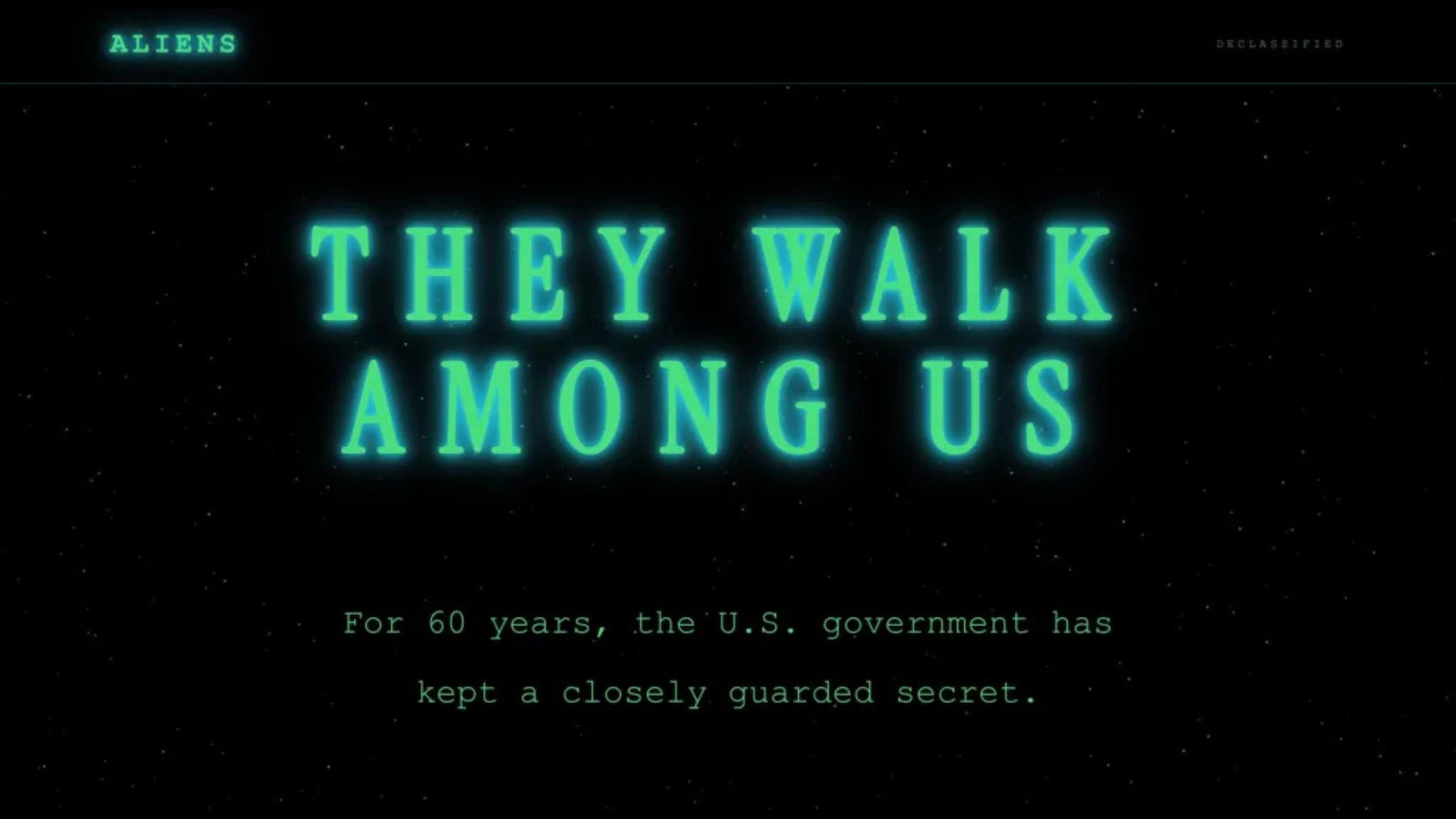
In May, the White House launched a website called Aliens.gov. Most people who saw the initial teaser assumed it was about UFOs. The domain name, the dark starry background, the glowing green text declaring “THEY WALK AMONG US” all pointed in that direction.
It wasn’t about UFOs.
The site uses extraterrestrial imagery and language borrowed straight from The X-Files to present immigration enforcement data. It refers to undocumented people using the pronoun “it.” It says they “do not belong here.” It invites Americans to report “suspicious aliens” to ICE.
Legal scholars at Just Security called it “dangerous speech” and noted that referring to human beings as “it” represents a recognizable escalation in dehumanizing political rhetoric.
Whether you see it as a joke in poor taste or something more sinister, it’s worth looking at this website through the lens of the Battle of the Story because whoever built it understands narrative power deeply.
In this case, here’s Their Story, broken down: The characters are a faceless, threatening mass. Not people with names and families, but “aliens,” invaders from outside who “do not belong here.” The conflict is framed as an invasion that has been covered up for decades, with ordinary Americans as the victims. The imagery borrows from science fiction and conspiracy culture, fusing fear of the unknown with fear of the immigrant. The foreshadowing is a return to safety, order, and a nation that has been “taken back.”
And the underlying assumption holding all of it together? That immigrants are fundamentally Other People. That their presence is a threat, not a contribution. That communities are safer, not richer, without them.
Those aren’t new assumptions. They’ve been quietly embedded in anti-immigrant messaging for decades. What Aliens.gov did was give them a platform, a visual language, and a viral moment—turning a bureaucratic enforcement dashboard into a cultural event that reached people who had never engaged with immigration policy before.
Now consider what Our Story needs to do.
It can’t just argue with the facts on the website, although the factual problems are significant, including data that doesn’t match independent analysis. The counter-narrative has to challenge the underlying belief that immigrants are Other People—that their presence is a threat, that communities are better off without them.
It has to center different characters: the neighbor, the teacher, the small business owner, the family who has been here for 20 years. It has to use different imagery: belonging, contribution, community, history. It has to name a different conflict: not invasion, but the choice between a nation that sees the humanity in everyone and one that doesn’t. And it has to make a different future feel not just possible, but inevitable—a future where these communities are recognized as essential to the fabric of American life.
That is the Battle of the Story. And it is happening right now, in real time, in your sector.
What this looks like closer to home
You don’t have to be an immigration organization for this to be relevant to your work. The same dynamic is playing out across every corner of the social impact sector right now.
If you run a youth development program, the dominant narrative might be: “Kids from this neighborhood don’t have what it takes.” The underlying assumption: poverty is a predictor of potential.
If you run a health equity organization for communities of color, the dominant narrative might be: “Those communities don’t take care of themselves.” The underlying assumption: the barrier is cultural, not structural.
If you advocate for housing justice, the dominant narrative might be: “There aren’t enough resources to house everyone.” The underlying assumption: scarcity is natural, not manufactured by policy choices.
In each case, your storytelling is either challenging those assumptions or accidentally reinforcing them. There is no neutral ground.
Here’s a quick example that makes this more concrete…
Imagine a tenant rights coalition organizing against a luxury development that will displace a low-income neighborhood. A traditional power analysis tells them who the decision-makers are, who’s funding the campaign, and where the political pressure points are. That’s essential. But the Battle of the Story asks them to go one layer deeper: what narrative is making this displacement feel acceptable, or even inevitable, to the people who need to stop it?
The developers’ story might be “bringing growth and opportunity to an underserved community.” Sounds reasonable, right? But the underlying assumption baked into that story is that the current residents aren’t a legitimate part of the community’s future. That the neighborhood’s value is in its real estate, not its people. That progress looks like replacement.
Once the coalition names that assumption, they can challenge it directly. They don’t just argue against the development—they build a counter-story that puts longtime residents at the center as the neighborhood’s real stakeholders, its historians, its economic backbone. They make a different future feel possible. And, suddenly, the developers aren’t “bringing opportunity” anymore. They’re erasing a community that was already thriving on its own terms.
That is the Battle of the Story in action.
Where this lives in our work at Community Symbol
This framework isn’t just something we talk about. It’s the foundation of one of the most important layers of what we call Community OS, the operating system we build with and for every client.
Specifically, the Battle of the Story lives at the heart of our Message Intelligence layer.
Message Intelligence is where we do the deep work of surfacing the core narrative that makes your organization’s work impossible to ignore. Not another mission statement. Not just talking points. The deeper story that positions your organization as a necessary voice in the conversation already happening in your sector.
This is your Battle of the Story foundation: the narrative that actively challenges the dominant assumptions about your community, your issue, and your work.
It’s what we call your unfair advantage, articulated—the thing that only your organization can say, from your specific position, with your specific history and relationships and lived knowledge, that no one else can replicate.
When we build Message Intelligence with a client, we’re doing exactly what the Battle of the Story asks: we’re getting honest about the storytelling arena they’re operating inside, naming the underlying assumptions that are making their community’s story harder to tell, and building the counter-narrative that their content strategy can carry forward consistently across every email, every funder update, every social media post, every board presentation.
Because here’s the thing most communications strategies miss: It’s not about saying the right things more often. It’s about making sure everything you say is pulling in the same direction—toward the future you’re trying to build and away from the assumptions that are standing in the way.
Bottom line: Your story is already in the fight. The question is whether you’re leading it.
The dominant narratives in your sector right now—about your community, your issue, your organization’s role—aren’t winning because they’re the most truthful. They’re winning because they’re being told consistently, loudly, and with a lot of institutional backing behind them.
The underlying assumptions embedded in those stories are getting reinforced every single day.
Your job isn’t just to work harder. It’s to tell a better, more soulful story—one that challenges those assumptions at the root, centers the people your work is actually for, and makes the future you’re building feel not just possible, but inevitable.