
Most justice-motivated organizations are better at doing the work than talking about it. That gap is costing them more than they realize.
Last month, we introduced the Battle of the Story framework from the Center for Story-based Strategy and walked through one of the most vivid real-world examples of narrative power we’ve seen in years. That framework gives you the lens—the ability to see the narrative landscape you’re operating inside and understand whose story is winning.
This month, we’re talking about what you do with it.
Because understanding the Battle of the Story is one thing. Actually stepping into it—owning your narrative with enough clarity and conviction that your community, your funders, and your coalition partners all feel it—is another thing entirely.
Here’s what that actually looks like.
Owning your narrative means three things
1. Shape the story that defines your work
Not just what you do. Why it matters. And what would be lost if you stopped.
This is the part most organizations skip. They describe their programs. They list their services. They report on their latest work. And none of it answers the question that every funder, every community member, and every potential partner is quietly asking: Why does this organization need to exist?
The organizations that answer that question clearly and consistently are the ones that build lasting trust. Not because they’re louder, but because they’ve done the harder work of translating their impact into meaning.
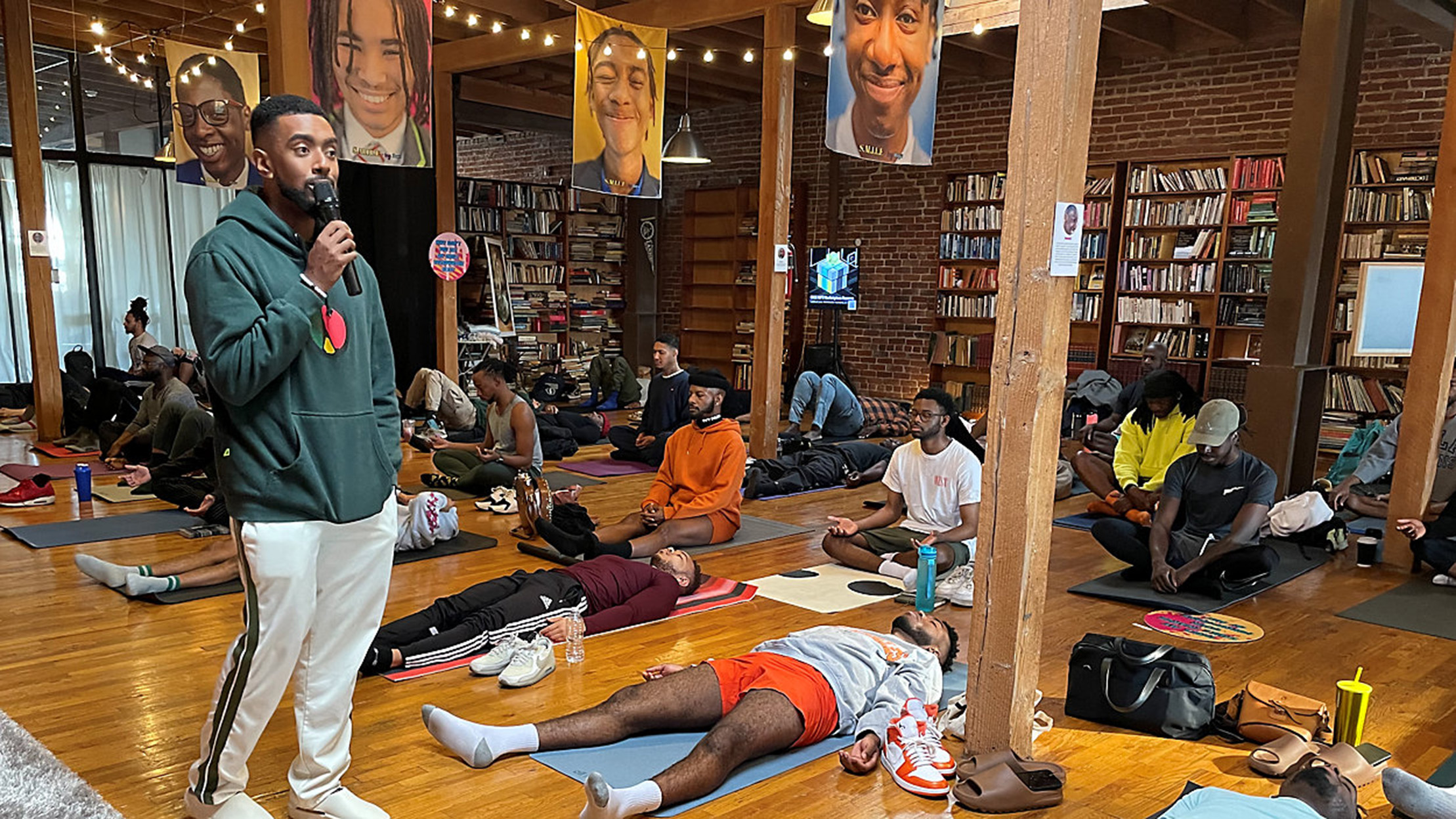
Take You Good? Men’s Healing Circles in Los Angeles. On the surface, you might describe what they do as yoga and wellness programming for Black men. But that description misses the entire point, and they know it. Their story is that Black men deserve spaces to be honest, supported and seen.
What happens in those circles—the yoga, the breathwork, the conversation—is the vehicle. The real work is creating a space where Black men can confront generations of racial trauma, let down their guard, and be in community with each other in a way that mainstream society rarely makes room for.
That story changes everything: who shows up, who funds them, who refers people to them, and how their community experiences what they’ve built. It’s not a program description. It’s a reason to exist.
What’s the story that defines your work at that level? If you can’t say it in two sentences, that’s where to start.
2. Make your values visible in everything you put out
Not just in your mission statement. In the tone, the specific words, the images, the examples you choose and the ones you don’t.
This is where a lot of organizations have a gap they don’t even know exists. Their values are clear internally. Everyone on the team knows what they stand for. But somewhere between the internal culture and the external communications, something gets lost. The website sounds too corporate. The newsletter sounds like a report. The social media content sounds like it was written by a PR consultant far removed from the community.
The reader can feel that gap. They may not be able to name it, but they feel it. And when communications don’t feel aligned with what an organization claims to stand for, trust erodes quietly and quickly.
More Perfect Union is one of the best examples we know of what it looks like when values are genuinely visible in the work. They cover the labor movement, workers’ rights, and economic justice, but they do it with the production quality and storytelling instincts of a VICE documentary. Underground but entertaining. Relatable but full of substance.
Every story is told explicitly from the perspective of working people, and you feel that point of view in every editorial choice they make: who gets interviewed, what questions get asked, what language gets used, what gets left on the cutting room floor.
You don’t have to read their mission statement to know what More Perfect Union believes. You feel it in the first 30 seconds of any video they put out. That alignment between values and voice is what makes their audience trust them enough to share their content, support their work, and keep coming back.
Ask yourself honestly: If someone consumed three months of your content without ever visiting your website, would they know what your organization stands for? Would they feel it?
3. Cast a vision of the future that makes people want to join you in building it
This is the piece that most justice-focused communications leave out entirely, and it might be the most powerful of the three.
Here’s the thing about the dominant narratives circulating about anything related to social justice right now: They’re not just arguing about the present. They’re arguing about what the future looks like. Who belongs in it. What’s possible. What’s inevitable.
And if your organization isn’t casting a clear, compelling vision of the future you’re working toward, you’re letting someone else define what’s possible for your community.
Every Day Is Juneteenth is doing this beautifully. They describe themselves as “The Black-Owned Online Bookstore,” but they’re not just selling books. Their content lifts up Black authors, many well known and many criminally underrated. They’re having public conversations about reparations well outside the month of June, when most mainstream organizations suddenly remember the holiday exists. They’re exploring topics like Whiteness Studies and publishing history and the politics of who gets to tell whose story.
What they’re really doing is casting a vision of a world where Black intellectual life is centered, celebrated, and commercially viable—not as a niche market but as a cultural imperative. Every book recommendation, every author spotlight, every conversation thread is a brick in that vision.
You’re not just buying a book. You’re investing in a future where Black stories are impossible to ignore.
That’s what a vision looks like when it’s working. It turns transactions into participation. It turns customers into community.
What future are you building toward? Can you describe it in a way that makes someone feel it, not just understand it?
Why all three have to work together
Here’s what we’ve seen in our work with justice-motivated organizations: Most are doing at least one of these three things reasonably well. A few are doing two. Almost none are doing all three consistently and intentionally across every storytelling channel.
And that inconsistency is expensive—not in dollars, but in trust.
When your story is clear but your values aren’t visible in your communications, people believe in your mission but don’t feel connected to your organization. When your values are visible but you haven’t cast a vision, people feel the passion but don’t know how to join you. When you have a vision but haven’t shaped the deeper story of why your work matters, the vision feels abstract—inspiring in theory but not compelling enough to act on.
All three working together is what we mean when we talk about owning your narrative. It’s more than having a tagline or doing a rebrand. It’s about having a coherent, intentional story that runs through everything you put out, and it’s about what sharing makes your organization feel not just relevant, but necessary.
Where this lives in our work at Community Symbol
Owning your narrative is the O in our C.O.M.M.U.N.I.T.Y. framework, and it’s the foundation of the Message Intelligence layer inside Community OS, the communications system we build with every client.
Message Intelligence is where we surface the core narrative that makes your organization’s work impossible to ignore. We help you shape the story that defines your work, make your values visible across every storytelling channel, and build a vision of the future compelling enough to move people toward it.
It’s what we call your unfair advantage, articulated. The thing that only your organization can say, from your specific position, with your specific history and relationships and lived knowledge, that no one else can replicate.
Octavia Butler once wrote that the only lasting truth is change.
That means the dominant narratives in your sector will shift—they always do. But what determines which future emerges from that shift is whom showed up to tell the story of what was possible.
Your organization carries a vision of the future that nobody else can replicate. The question isn’t whether that vision matters. It’s whether you’re willing to say it out loud, consistently and on purpose, until the world catches up to what you already know is true.